


Hypervisor “cracks” have quickly turned into the loudest Denuvo storyline of the year, mostly because they’ve been attached to some genuinely huge names. In just a short stretch of time, Reddit has been flooded with Hypervisor-labeled releases for games like Resident Evil Requiem, Black Myth: Wukong, Persona 3 Reload, Stellar Blade, and Borderlands 4 — plus other high-profile targets that normally sit behind a long, painful Denuvo wait.
That wave alone has been enough to shift the mood, but it also came with a major downside: most Hypervisor setups have required security trade-offs and BIOS/Windows changes that many players simply refuse to touch.
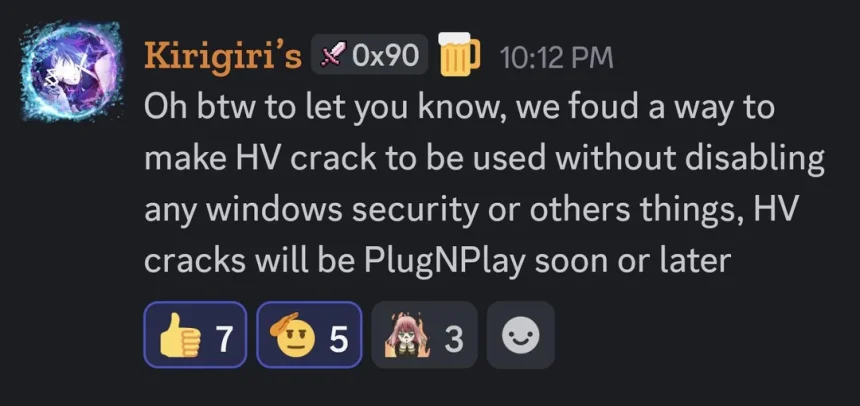
Now there’s a new claim spreading fast that could remove that biggest barrier altogether. A widely shared Discord screenshot attributed to Kirigiri suggests that a major change is coming. In the message, he claims they have found a way to run Hypervisor cracks without disabling Windows security or other protections, and that Hypervisor releases could become “plug and play” in the near future.
“Oh btw to let you know, we found a way to make HV crack to be used without disabling any windows security or others things, HV cracks will be PlugNPlay soon or later”
— Kirigiri (Discord screenshot)
If that turns out to be true, it would remove the biggest barrier that has made many players hesitant about Hypervisor releases: the current setup often involves BIOS toggles, virtualisation changes, and security trade-offs that feel risky for a gaming PC.
Why this matters
Right now, the Hypervisor scene is split into two camps: people who are willing to jump through the setup hoops to play Denuvo-protected titles, and people who refuse to touch it because they don’t want to disable protections or install low-level components they can’t audit.
If Hypervisor really becomes a “no security changes required” solution, the second group suddenly has a reason to reconsider. That doesn’t automatically make Hypervisor “safe” or “clean” — you’re still trusting a workaround that operates at a deeper level than a traditional crack — but it could make it accessible enough to spread far beyond the usual niche.
Hypervisor vs proper cracks
It’s also important to keep the terminology straight. Hypervisor releases are usually workarounds that keep Denuvo inside the game and manipulate checks externally, while a proper Denuvo crack typically patches the executable so it runs without Denuvo. That difference affects stability, preservation, and risk.
If you want the full breakdown (and why many players still prefer a proper crack), read our explainer here: Hypervisor cracks vs proper Denuvo cracks.
Where voices38 fits into this
At the same time as the Hypervisor wave, another storyline has been building in parallel: voices38 has been quietly cracking older Denuvo titles that had sat on “uncracked” lists for years. That matters because it shows two very different paths attacking the same problem.
Hypervisor workarounds are about making newer protected games playable through a new layer of tooling. Voices38’s work is about clearing out the backlog the “old way,” game by game, in a more traditional cracking style.
Is this really the “end of Denuvo”?
It’s tempting to call this the beginning of the end, but it’s still just a claim based on a screenshot, not a public technical release. Even if Hypervisor becomes easier to use, Denuvo and publishers can react: updates can harden checks, shift triggers server-side, or add new layers that change the equation again.
One thing is certain, though: if the biggest practical downside of Hypervisor (security changes and setup friction) disappears, Denuvo’s “uncracked window” could shrink dramatically for a lot of high-profile games.
So far, Irdeto (Denuvo’s owner) has not made any public statement addressing the recent surge of Hypervisor-based bypasses or the renewed wave of Denuvo cracking activity. Until that changes, we’re left watching the scene’s next move — and waiting to see whether this “plug and play” promise turns into something real.