


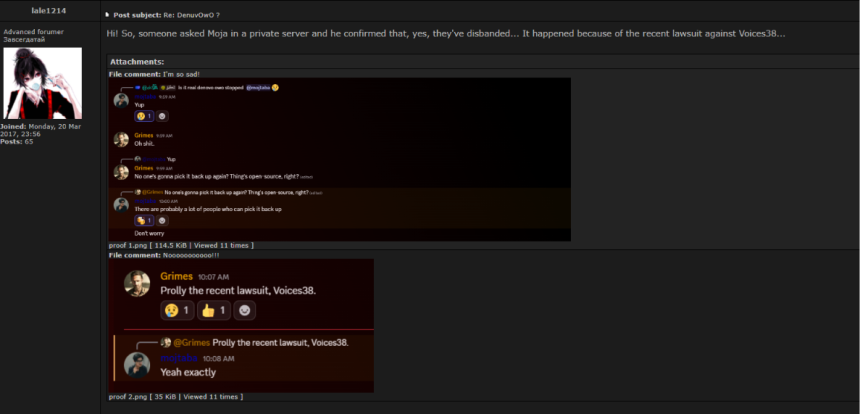
DenuvOwO, the group behind the Hypervisor-based Denuvo bypasses that changed the crack scene throughout 2026, has reportedly disbanded.
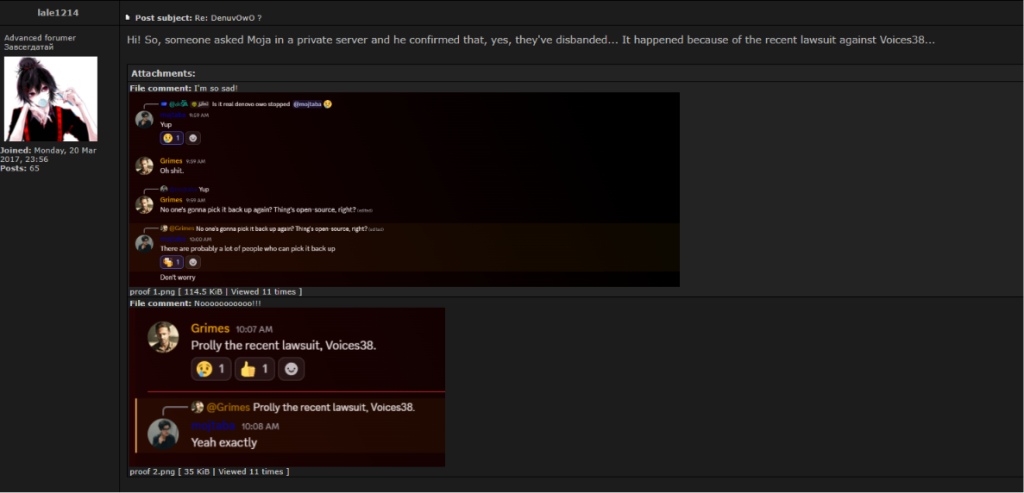
The confirmation appears to come from a CS.RIN discussion sharing screenshots from a private server. According to the post, a community member asked Mojtaba, one of the names closely associated with the project, whether DenuvOwO had stopped. His answer was reportedly yes.
More importantly, when another user suggested the recent voices38 lawsuit was probably the reason, Mojtaba replied: “Yeah exactly.”
If accurate, this would make DenuvOwO one of the first visible casualties of the legal pressure that followed Denuvo’s case against voices38.
The voices38 Lawsuit May Have Changed The Risk Completely
DenuvOwO itself was not the named defendant in Denuvo’s lawsuit, but that may not matter much from the group’s perspective.
Earlier this month, Denuvo filed a major DMCA anti-circumvention case against voices38, accusing the cracker of bypassing its Anti-Tamper technology across more than two dozen games. We covered the full filing in our report on the Denuvo lawsuit against voices38.
That lawsuit changed the atmosphere almost overnight.
Before the case, cracking and bypass groups were mostly fighting Denuvo on the technical side. Now there is a second threat: identification through courts, subpoenas, platform records, Discord accounts, Reddit history, Steam profiles, and anything else that could eventually connect an anonymous alias to a real person.
For a group maintaining a public Hypervisor project, that risk is very different from simply wondering whether Denuvo will patch the next bypass.
DenuvOwO May Be Gone, But Hypervisor Is Not Necessarily Dead
This is where the story becomes more complicated.
In the screenshots shared from the private discussion, another user asks whether someone could simply pick the project back up because parts of it are open source.
Mojtaba’s response is surprisingly optimistic:
“There are probably a lot of people who can pick it back up. Don’t worry.”
That may be the most important sentence in the entire story.
DenuvOwO can disband as a group without the underlying idea disappearing. The Hypervisor approach is already understood far more widely than it was at the beginning of 2026, and parts of the ecosystem have been publicly documented, studied, ported to Linux, and modified by other developers.
So calling this “the end of Hypervisor cracks” would be premature.
What may be ending is the era where DenuvOwO itself was the trusted name releasing them.
That difference matters.
The Scene Is Already Moving Beyond One Group
The timing is also interesting because DenuvOwO is disappearing at the same moment another old scene name has suddenly returned to the Denuvo conversation.
RUNE recently published a proof of concept for Assassin’s Creed Mirage that reportedly went much further than a Hypervisor bypass. Instead of creating an environment around Denuvo, the project claims to have removed Denuvo and VMProtect from the executable itself.
We covered that separately in RUNE Fully Removes Denuvo And VMProtect From Assassin’s Creed Mirage.
That release is important here because it shows why DenuvOwO disappearing does not automatically mean Denuvo has won.
The methods are changing.
Hypervisor bypasses became one path. voices38 brought proper cracks back into the conversation. RUNE has now demonstrated a completely different proof-of-concept approach based around stripping protection from the executable.
The scene is fragmented, but it is not standing still.
So, Is Hypervisor Dead?
Probably not.
DenuvOwO reportedly disbanding is still a major blow because it removes the most recognizable and trusted group behind the current Hypervisor releases. New developers may not have the same testing network, experience, or reputation, and users should be especially cautious about unknown groups suddenly distributing low-level software under the promise of “continuing DenuvOwO.”
But technically, the idea is already out there.
The real effect of the voices38 lawsuit may therefore be less about killing Denuvo cracking and more about forcing the scene back underground. Groups may become smaller. Communication may become less public. Releases may take longer. Developers may stop attaching recognizable names to their work.
That could slow things down significantly.
But between the Hypervisor knowledge already circulating, voices38’s recent run, and RUNE experimenting with full Denuvo removal, it is difficult to call this the end.
DenuvOwO may be finished.
The Hypervisor story probably is not.