

Dragon's Dogma 2: Dark Arisen Expansion



Dragon’s Dogma 2: Dark Arisen Expansion officially releases on October 9, 2026, for PC, PlayStation 5, Xbox Series X|S, and Nintendo Switch 2, with Steam showing an October 8 unlock in some time zones. Developed and published by CAPCOM Co., Ltd., this paid expansion sends the Arisen north to Norgan, a long-abandoned snowy region where the mysterious Eir is investigating the immortal Fallen Dragon. The expansion introduces the Forsaken Dominion storyline, forgotten relics that unlock new weapons and skills, 12 new dungeon challenges spread through the original world, additional equipment, new hairstyles and tattoos, tougher late-game encounters, and an expedition-focused progression loop designed around repeated journeys into dangerous territory with the Pawn party.
DLC
- Dark Arisen Expansion: Adds the Norgan region and Forsaken Dominion storyline, the Fallen Dragon, new relics, weapons and skills, 12 Lost Rites dungeon challenges, rare equipment, and additional character creation options.
- Pre-order Bonus: Includes the Norgan Fashion Set – Northern Attire.
Editions – what’s included
- Dark Arisen Expansion: Standalone DLC for existing Dragon’s Dogma 2 owners on PC, PlayStation 5, and Xbox Series X|S. The base game is required.
- Dragon’s Dogma 2: Dark Arisen: Includes Dragon’s Dogma 2, the Dark Arisen Expansion, Explorer’s Camping Kit, and Dragon’s Dogma Music & Sound Collection.
- Nintendo Switch 2 Edition: Includes Dragon’s Dogma 2 and the Dark Arisen Expansion together in one package.
- Pre-order Bonus: Includes the Norgan Fashion Set – Northern Attire.
Review
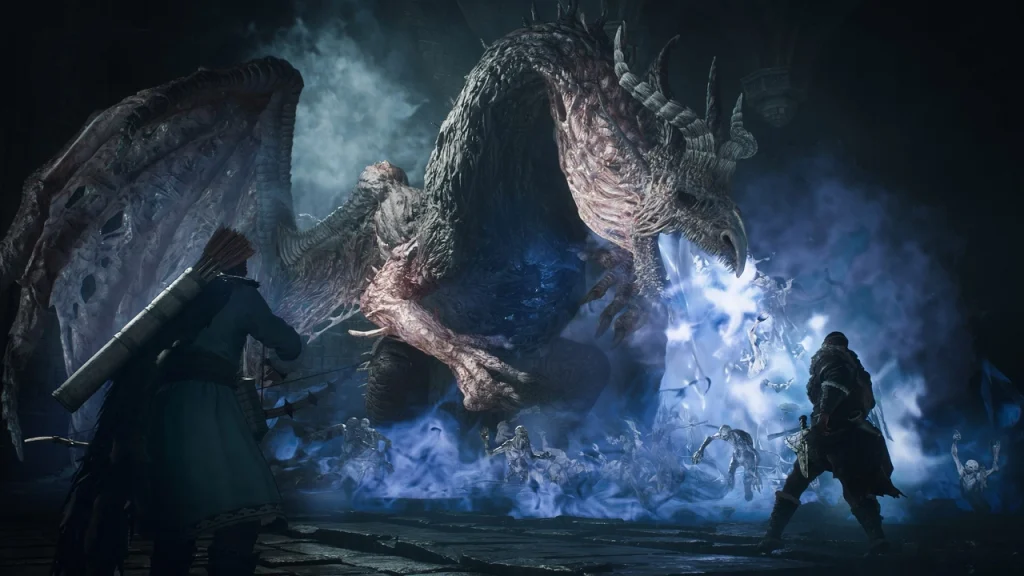
Dark Arisen gives Dragon’s Dogma 2 something its original endgame often lacked: a concentrated reason to keep developing an experienced Arisen and Pawn party. Norgan is designed as a new northern region rather than another collection of encounters placed around Vermund and Battahl, allowing the expansion to establish its own atmosphere, enemies, equipment, and progression.
The Forsaken Dominion storyline revolves around Eir and the immortal Fallen Dragon, but the relic system may have the greater impact on character builds. Forgotten relics can be appraised to unlock new weapons and powerful skills, giving exploration a direct mechanical reward instead of simply adding more materials to existing inventories.
Lost Rites extends that progression back into the original world through 12 newly discovered dungeon challenges. Rare equipment once used by previous Arisens waits inside, providing dedicated combat tests for players who already understand their vocation and party composition.
Capcom recommends approximately level 40 for the beginning of Forsaken Dominion and level 20 for Lost Rites, although both can be accessed relatively early after reaching Vernworth. That flexibility should make the expansion useful for both returning saves and new playthroughs.
Character creation also receives new hairstyles and tattoos, while recent base-game updates improve performance and quality-of-life features for everyone.
The main question is how much enemy and dungeon variety Norgan can sustain. Dragon’s Dogma 2 already has excellent combat, so repeated encounters need meaningful new behaviors rather than simply higher health and damage.
Verdict: A substantial expansion that gives Dragon’s Dogma 2 a dedicated high-level region, new build progression, and the dungeon-focused challenge structure its endgame needed.
PC System Requirements
| Component | Minimum | Recommended |
|---|---|---|
| OS | Windows 11 64-bit | Windows 11 64-bit |
| CPU | Intel Core i5-8500 or AMD Ryzen 5 3500 | Intel Core i7-10700 or AMD Ryzen 5 3600X |
| Memory | 16 GB RAM | 16 GB RAM |
| Graphics | Nvidia GeForce GTX 1660 or AMD Radeon RX 5500 XT with 8 GB VRAM | Nvidia GeForce RTX 2070 Super or AMD Radeon RX 6600 XT |
| Storage | — | — |
Supported Languages
| Language | Interface | Full Audio | Subtitles |
|---|---|---|---|
| English | ✔ | ✔ | ✔ |
| French | ✔ | — | ✔ |
| Italian | ✔ | — | ✔ |
| German | ✔ | — | ✔ |
| Spanish – Spain | ✔ | — | ✔ |
| Arabic | ✔ | — | ✔ |
| Spanish – Latin America | ✔ | — | ✔ |
| Portuguese – Brazil | ✔ | — | ✔ |
| Polish | ✔ | — | ✔ |
| Russian | ✔ | — | ✔ |
| Simplified Chinese | ✔ | — | ✔ |
| Traditional Chinese | ✔ | — | ✔ |
| Japanese | ✔ | ✔ | ✔ |
| Korean | ✔ | — | ✔ |