


Modulus: Factory Automation



Modulus: Factory Automation releases April 2, 2026 on PC. Developed by Happy Volcano and published by Kwalee, it’s a factory builder that puts creativity at the center of automation by letting you design the building blocks themselves. You cut, stamp, paint, and assemble 3D modules, then use those custom parts to build production lines that can be functional, compact, or absurdly pretty. The goal is the usual factory-game satisfaction, but with a strong “this is yours” angle baked into every layout.
DLC
- Modulus Soundtrack
Editions – what’s included
No special editions confirmed at this time.
Review
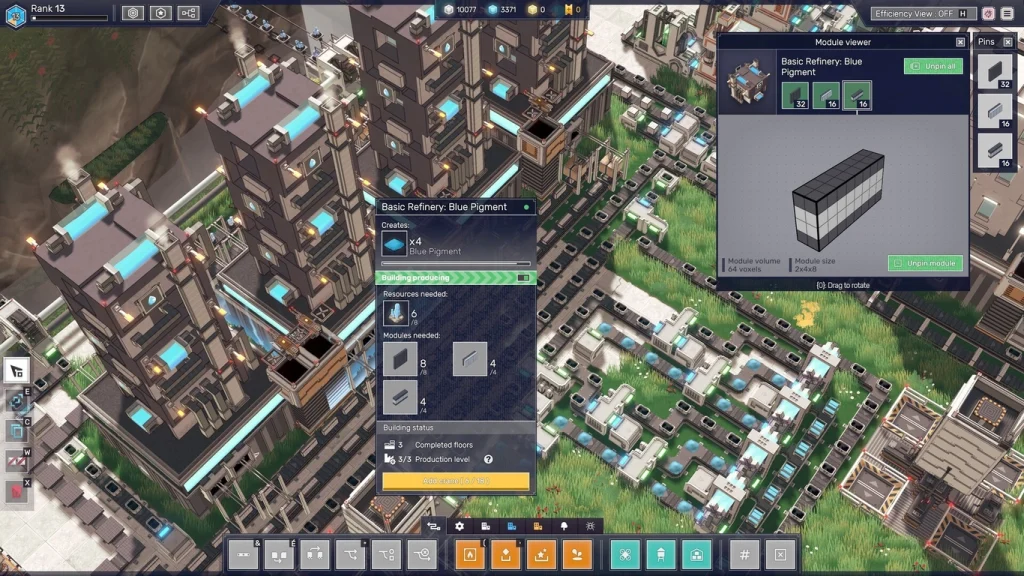
Modulus: Factory Automation is interesting because it doesn’t start by asking you to optimize. It starts by asking you to create. The core idea, designing your own modules before you even place them in a line, changes the typical factory-game mindset. Instead of only thinking about ratios and belt math, you’re thinking about shapes, workflows, and how you want your solutions to look.
That extra layer can make automation feel more personal. A good factory builder gives you that quiet “I made this work” pride, but Modulus pushes it further. When a system runs smoothly, you’re not just proud of the throughput, you’re proud of the object you built to enable it. It’s a small shift, but it can keep late-game expansion from turning into pure routine.
The main risk is friction. Adding a creative step can be empowering, but it can also be slow if the tools aren’t snappy. The interface needs to make iteration painless, because factory games are basically one long process of adjusting and re-adjusting. The other concern is clarity. With custom modules, players need strong visual language so a sprawling setup stays readable at a glance.
If those pieces land, Modulus could sit in a nice niche: less sterile than pure logistics puzzles, less chaotic than full sandboxes. It’s for people who like efficiency, but also want their factory to look like a thing they’d show off.
Verdict: A smart twist on factory automation that adds real creative ownership, as long as its building tools stay fast and its systems stay readable when the factories get big.
PC System Requirements
| Component | Minimum | Recommended |
|---|---|---|
| OS | Windows 10 64bit | Windows 10 64bit |
| CPU | 4-core 2.3 GHz | 4-core 2.9 GHz or better |
| Memory | 6 GB RAM | 16 GB RAM |
| Graphics | Geforce GTX 1660, Radeon RX 590 | Geforce RTX 3060, Radeon RX 6600 XT |
| Storage | 10 GB available space | 15 GB available space |