


Hearth and Hamlet


Hearth and Hamlet releases on August 19, 2026, for PC and Linux. Developed by Phorust Studios and published by Runic Forge and Gamersky Games, this incremental medieval city builder begins with little more than a campfire before gradually expanding into a functioning kingdom. Players gather food, wood, stone, iron, and gold, assign workers, construct settlements, research technologies, establish laws, collect taxes, trade with neighboring lands, recruit soldiers, unlock alchemy and magic, and develop everything from simple tents and taverns to castles, academies, ports, and fortified districts.
DLC
No DLC announced at this time.
Editions – what’s included
No special editions confirmed at this time.
Review
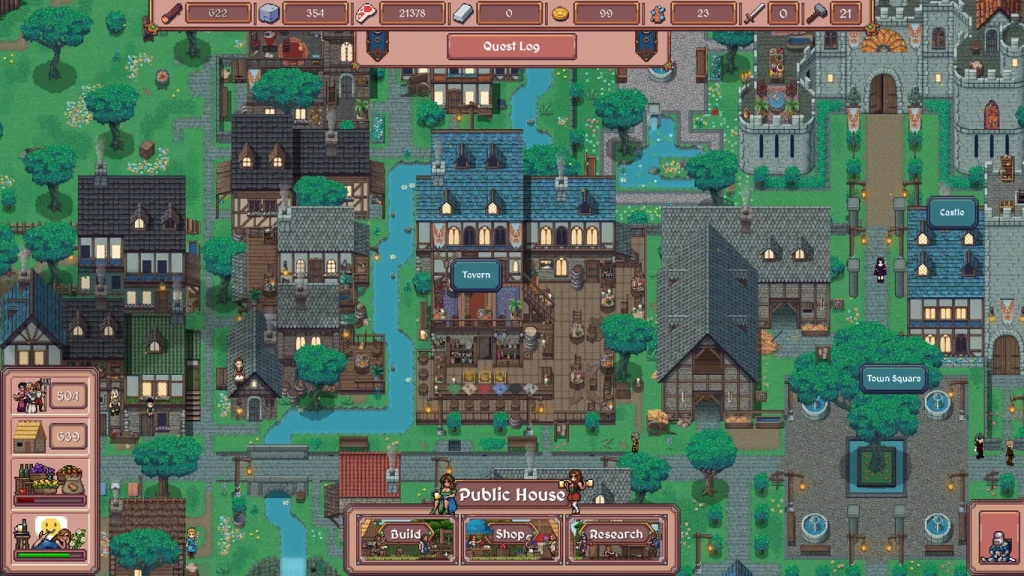
Hearth and Hamlet combines city building with an incremental structure that allows the settlement to continue producing and progressing without demanding constant input. Early development begins with basic workers and resource collection, but every improvement feeds into increasingly complex buildings, policies, technologies, and trade.
Worker allocation provides the foundation. Food, wood, stone, iron, and gold must remain available as construction expands, forcing players to decide which resources deserve attention. Buildings can then be upgraded repeatedly, turning simple production chains into a steadily growing kingdom rather than forcing players to rebuild entire districts.
Government systems add another layer. Laws can alter taxation, worker morale, population behavior, and military preparation, while research permanently unlocks new technologies. Magic enters later through systems such as alchemy and magical academies, giving the progression curve somewhere unusual to go once the medieval economy is established.
Trade provides access to resources unavailable locally, while soldiers and fortifications protect accumulated wealth. The pixel-art presentation keeps the kingdom readable even as the number of buildings increases, and the idle component makes slower growth feel intentional rather than inefficient.
The tradeoff is that players looking for detailed logistics or direct control over individual citizens may find the incremental design too automated. Much of the satisfaction comes from watching numbers and production improve over time rather than solving difficult transport problems.
Verdict: A relaxing incremental city builder with enough laws, research, trade, and magic to keep its campfire-to-kingdom progression interesting.
PC System Requirements
| Component | Minimum | Recommended |
|---|---|---|
| OS | Windows 10 64-bit | Windows 11 64-bit |
| CPU | Intel Core i3 @ 3.2 GHz or AMD equivalent | Intel Core i5-2400 @ 3.1 GHz or AMD equivalent |
| Memory | 8 GB RAM | 8 GB RAM |
| Graphics | Nvidia GeForce GTX 650 2 GB or AMD Radeon HD 7770 2 GB | Nvidia GeForce GTX 750 Ti 2 GB or AMD Radeon R7 260X 2 GB |
| Storage | 1 GB available space | 1 GB available space |
Supported Languages
| Language | Interface | Full Audio | Subtitles |
|---|---|---|---|
| English | ✔ | ✔ | ✔ |
| Simplified Chinese | ✔ | ✔ | ✔ |
| German | ✔ | ✔ | ✔ |
| Japanese | ✔ | ✔ | ✔ |
| Russian | ✔ | ✔ | ✔ |
| Korean | ✔ | ✔ | ✔ |
| Traditional Chinese | ✔ | ✔ | ✔ |