


County of Fortune


County of Fortune enters Early Access on November 5, 2026, for PC and Linux. Developed by Nepos Games and published by Aquila Interactive, this medieval city builder expands the usual single-settlement formula into an entire county containing multiple villages, towns, roads, rivers, noble families, cultures, and local governments. Players establish settlements across a large landscape, develop production chains, move goods between communities, manage regional trade, assign responsibilities to mayors, respond to the influence of noble houses, and shape a county whose economy and identity emerge from relationships between several settlements rather than one expanding city.
DLC
No DLC announced at this time.
Editions – what’s included
No special editions confirmed at this time.
Review
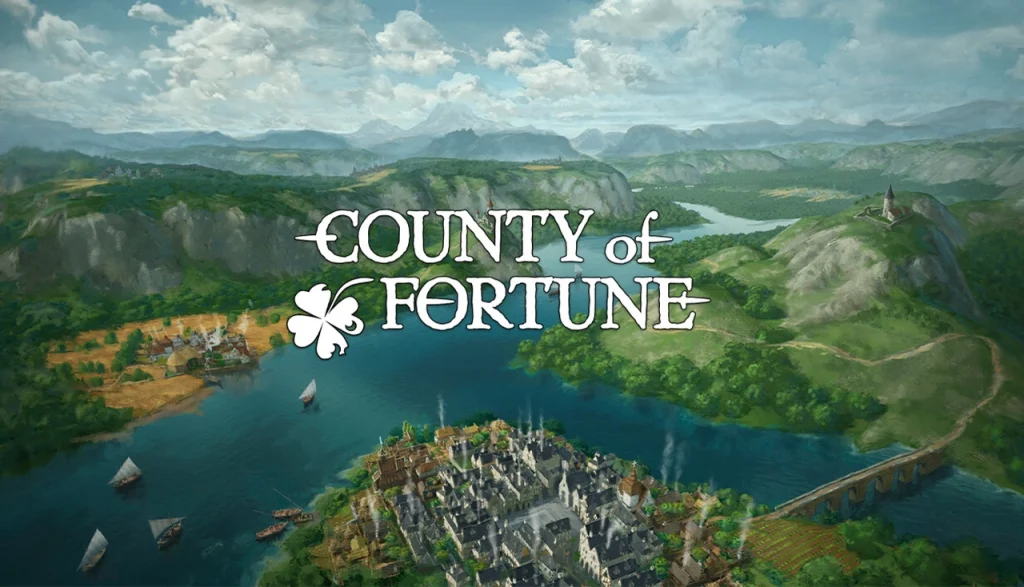
County of Fortune’s strongest idea is scale, but not in the usual city-builder sense. Instead of simply giving players a larger map for one enormous city, it expects several settlements to develop alongside each other and depend on shared infrastructure.
That changes how production chains are planned. A village positioned near one resource may specialize in producing a particular good, while another settlement becomes a trading or administrative center. Roads and rivers then become economic arteries connecting separate communities rather than decorative routes inside one urban area.
Mayors and noble houses add a political layer to that structure. Local leadership, cultural differences, and regional priorities can shape how settlements evolve, preventing every town from becoming an identical collection of optimal buildings.
The landscape itself also matters. Wide maps encourage players to consider geography before founding a new settlement, particularly when rivers, resource deposits, and trade routes can determine whether a location becomes prosperous or expensive to maintain.
Because the game is entering Early Access, many of these systems will continue changing based on player feedback. That is particularly important for balancing an economy where several independent settlements interact at once.
The main concern is management overhead. Coordinating multiple towns could become more exhausting than strategic if information is difficult to access or local automation is too limited.
Verdict: A promising medieval builder that treats an entire county as the basic unit of play, giving trade, settlement specialization, and regional politics far more importance than conventional single-city expansion.
PC System Requirements
| Component | Minimum | Recommended |
|---|---|---|
| OS | Windows 7 and higher | Windows 7 and higher |
| CPU | Intel Core i3 or equivalent | Intel Core i5 or equivalent |
| Memory | 3 GB RAM | 4 GB RAM |
| Graphics | Nvidia GeForce GTX 770 / AMD Radeon R9 290 | Nvidia GeForce GTX 970 / AMD Radeon R9 390 |
| Storage | 2 GB available space | 2 GB available space |
Supported Languages
| Language | Interface | Full Audio | Subtitles |
|---|---|---|---|
| English | ✔ | — | ✔ |
| German | ✔ | — | ✔ |
| Czech | ✔ | — | ✔ |
| French | ✔ | — | ✔ |
| Polish | ✔ | — | ✔ |
| Simplified Chinese | ✔ | — | ✔ |
| Traditional Chinese | ✔ | — | ✔ |
| Spanish – Spain | ✔ | — | ✔ |
| Portuguese – Brazil | ✔ | — | ✔ |
| Portuguese – Portugal | ✔ | — | ✔ |
| Spanish – Latin America | ✔ | — | ✔ |
| Japanese | ✔ | — | ✔ |
| Korean | ✔ | — | ✔ |
| Turkish | ✔ | — | ✔ |
| Ukrainian | ✔ | — | ✔ |
| Italian | ✔ | — | ✔ |
| Russian | ✔ | — | ✔ |