




Screenbound releases on September 10, 2026, for PC. Developed by Crescent Moon Games and Radical Forge and published by Digital Pajamas and Crescent Moon Games, this first-person puzzle-platforming adventure begins when the player discovers a strange handheld console called the Qboy inside their mother’s garage. Activating it splits reality between a stylized three-dimensional world and a retro two-dimensional platform game displayed on the device. Players control both versions of the character at the same time, solve perspective-based puzzles, fight enemies, unlock new tools, and uncover the story behind the divided worlds.
DLC
No DLC announced at this time.
Editions – what’s included
No special editions confirmed at this time.
Review
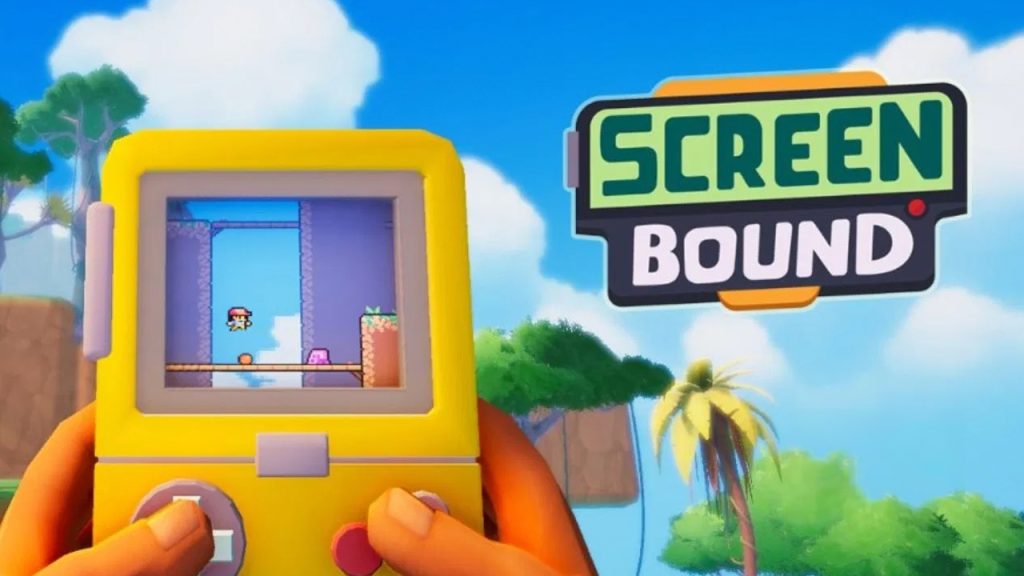
Screenbound takes a familiar platforming idea and makes it physically difficult to process. The player moves through a first-person 3D environment while simultaneously controlling a 2D character on the Qboy screen. One input affects both versions, but obstacles, enemies, and platforms do not always exist in both realities.
This creates puzzles built around divided attention. A safe jump in the handheld game may move the 3D character toward a wall or ledge, while a clear corridor in the larger world may hide an enemy on the screen. Progress depends on reading both spaces quickly and understanding which version currently carries the important information.
The game can also shift focus between dimensions. Some sections require direct interaction with the 3D environment, while others behave more like a traditional pixel-art platformer. New tools and abilities gradually expand the number of ways the two realities can affect each other.
Its presentation helps separate the layers. The handheld uses clean retro sprites, while the surrounding world relies on stylized 3D environments and first-person movement. That contrast makes the central mechanic easier to read without removing the intended confusion.
The concept may become mentally tiring during longer sessions, especially when precise platforming is required in both views. The Steam storage figures of 2 MB and 4 MB also appear unusually low, although they are the values currently listed.
Verdict: An inventive puzzle-platformer that turns controlling two synchronized realities into a clever test of perspective, timing, and concentration.
PC System Requirements
| Component | Minimum | Recommended |
|---|---|---|
| OS | Windows 10 Home Edition 64-bit | Windows 10 Pro Edition 64-bit |
| CPU | Intel Core i3 or better | Intel Core i7 or better |
| Memory | — | — |
| Graphics | Nvidia GeForce GT 720 | Nvidia GeForce GTX 960 |
| Storage | 2 MB available space | 4 MB available space |